Chevrolet and GM: How Reliable is the Oil Life % System?
Chevrolet and GM Oil Life System. General Motors (GM) was a pioneer in engine management when it introduced the Oil Life System (OLS) across its Chevrolet, GMC, Buick, and Cadillac lineups. For most modern owners, the “Oil Life %” display on the Driver Information Center (DIC) is the only guide they use for maintenance. However, a persistent question remains among enthusiasts and high-mileage drivers: How reliable is this percentage? Is it a sophisticated scientific calculation, or just a glorified odometer that encourages long intervals to lower “cost of ownership” ratings?
In this technical deep dive, we will analyze the mathematics behind the GM OLS, identify its blind spots, and determine if you should trust the 0% mark or stick to a traditional mileage-based schedule.
1. The Brains Behind the Percentage: The OLS Algorithm
Chevrolet and GM Oil Life System. The most critical thing to understand is that the GM Oil Life System does not physically sample the oil. There is no laboratory-on-a-chip testing for viscosity or acidity in your oil pan. Instead, it is a software-based “Virtual Sensor.”
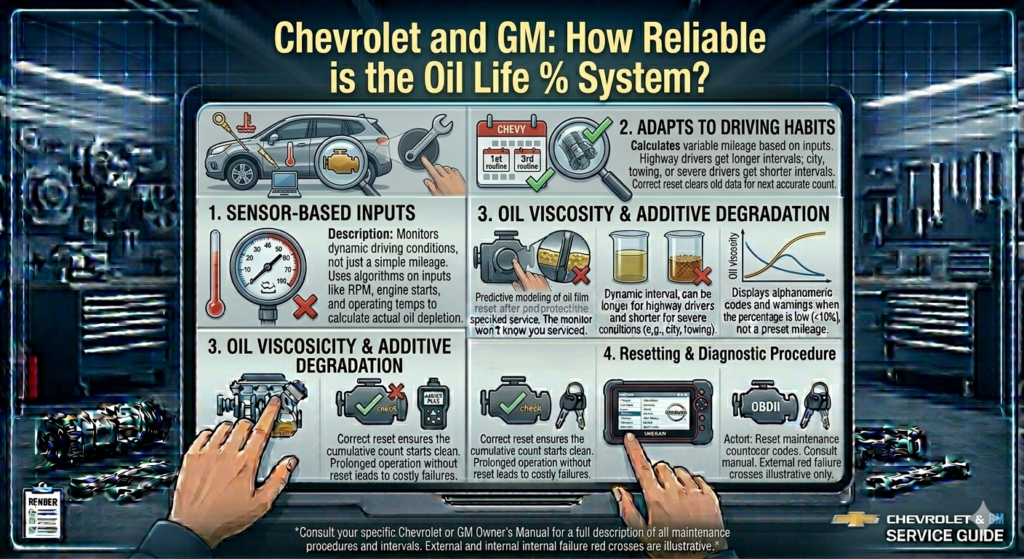
The algorithm, patented by GM, tracks every single engine revolution and applies “Penalty Factors” based on real-time data from the Powertrain Control Module (PCM).
-
Thermal Cycles: The system tracks how long it takes the engine to reach its optimal operating temperature. Frequent short trips where the oil stays cool (preventing moisture evaporation) cause the percentage to drop significantly faster.
-
Engine Revolutions: It literally counts millions of crank rotations. High RPM driving (towing or spirited driving) applies a higher penalty than low-RPM highway cruising.
-
Ambient Conditions: Newer versions of the OLS factor in outside air temperature. Running an engine in -10°F weather is far more taxing on the lubricant than in 70°F weather.
2. Where the OLS is Highly Reliable
Chevrolet and GM Oil Life System. In “Normal” and “Severe” driving conditions (as defined by standard commuting), the GM OLS is incredibly accurate.
-
Sludge Prevention: The system is designed to trigger a “Change Oil Soon” message before the oil’s Total Base Number (TBN)—the measure of its acid-neutralizing ability—reaches a critical failure point.
-
Adaptability: If you drive 500 miles on a highway, the life might only drop by 4%. If you drive 500 miles of stop-and-go delivery work in a cold climate, it might drop by 12%. This adaptability makes it far superior to a “fixed” 5,000-mile sticker.
3. The Blind Spots: When NOT to Trust the Percentage
Chevrolet and GM Oil Life System. Despite its sophistication, the OLS has three major technical “blind spots” that every Chevrolet or GMC owner should be aware of:
A. It Cannot Detect Oil Level
The OLS tracks the quality of the oil, not the quantity. You can have “90% Oil Life” remaining while your engine is 3 quarts low on oil. This is especially dangerous for older GM engines (like the early Ecotec or 5.3L Vortec with Active Fuel Management) that may consume oil. If the oil level is low, the remaining oil works harder and stays hotter, but the OLS doesn’t know the volume has decreased.
B. It Cannot Detect Contamination
Chevrolet and GM Oil Life System. If you have a leaking fuel injector (fuel dilution) or a head gasket leak (coolant in the oil), the OLS will continue to count down as if the oil is pure.
-
Fuel Dilution: Gasoline destroys oil viscosity. If your injectors are leaking, your oil could be “dead” at 50% life, but the computer will still show a healthy percentage.
-
Air Filter Integrity: If you drive in extremely dusty or sandy conditions (off-roading), silica particles can bypass a dirty air filter and enter the oil. The OLS has no way to “see” physical dirt or grit.
C. The “Wrong Oil” Variable
Chevrolet and GM Oil Life System. The OLS assumes you are using Dexos-approved synthetic oil. If you or a budget oil change shop use a low-grade conventional oil, the additives will deplete much faster than the algorithm predicts. In this scenario, the oil will fail chemically while the dashboard still shows 30% or 40% life remaining.
4. Technical Case Study: The 3.6L LFX/LLT Timing Chain Issue
A famous example of “trusting the light too much” occurred with GM’s 3.6L High Feature V6 engines. Owners who followed the OLS until 0% (which sometimes allowed for 10,000+ mile intervals) began experiencing timing chain stretch.
Chevrolet and GM Oil Life System. The oil was still “chemically” okay, but microscopic debris was wearing down the timing chain pins over long intervals. GM eventually issued a software update to “re-calibrate” the OLS, shortening the maximum allowed interval to roughly 7,500 miles to protect the hardware. This proves that even manufacturer algorithms are subject to “real-world” adjustments.
5. Reliability Summary Table
| Factor | OLS Reliability | Technical Reason |
| Normal Commuting | High | Accurately tracks thermal and RPM stress. |
| Highway Cruising | Very High | Excellent at extending intervals for stable temps. |
| Extreme Dust/Dirt | Low | Cannot detect physical particulates. |
| Oil Consumption | Zero | Does not monitor oil volume/level. |
| Old/Leaking Engines | Medium | Cannot detect fuel or coolant contamination. |
6. The Expert Strategy: The “20% Rule”
To maximize the life of a Chevrolet or GMC engine—especially those with turbochargers or Active Fuel Management (AFM)—most master technicians recommend the “20% Rule”.
-
Do not wait for 0%. Change the oil when the OLS reaches 20%. This provides a safety buffer against any unforeseen fuel dilution or mechanical wear that the algorithm might have missed.
-
Check the Dipstick: Check your oil level every 1,000 miles. The OLS is a “quality” monitor; the dipstick is your “quantity” monitor. You need both to be successful.
Conclusion: A Tool, Not a God
The Chevrolet/GM Oil Life System is one of the most reliable and well-tested algorithms in the automotive world. For 90% of drivers, it is a perfectly safe guide for engine maintenance. However, it is a mathematical estimate, not a physical analysis.
By understanding its limitations—specifically its inability to track oil levels and external contamination—you can use the OLS as a powerful tool rather than a blind rule. Use Dexos-certified full synthetic oil, replace your filter every time, and aim for a change at the 20% mark. This hybrid approach combines GM’s advanced software with traditional mechanical wisdom, ensuring your engine reaches the 200,000-mile milestone and beyond.