Chevrolet Oil Life System What Does That Percentage Mean?
Chevrolet Oil Life System. General Motors (GM) was a pioneer in moving away from the “3,000-mile myth.” Since the late 1990s, Chevrolet and GMC vehicles have been equipped with the Engine Oil Life System (OLS). This is not a simple mileage counter; it is a sophisticated software-based “watchdog” that tracks your engine’s health in real-time. Whether you are towing a trailer with a Silverado or commuting in an Equinox, the OLS translates your driving habits into a simple percentage. But what exactly is happening behind that “15% Oil Life” warning on your dashboard?
In this technical guide, we will break down the GM OLS algorithm, explain the critical importance of the Dexos oil specification, and show you exactly how to reset the system for different Chevrolet generations.
The “Penalty Factor”: How the OLS Algorithm Thinks
Chevrolet Oil Life System. One of the most common questions from Chevy owners is: “Is there a sensor actually testing the oil?” The answer is no. Instead, the computer (PCM) uses a mathematical model that treats the oil as a consumable resource that decays faster under stress.
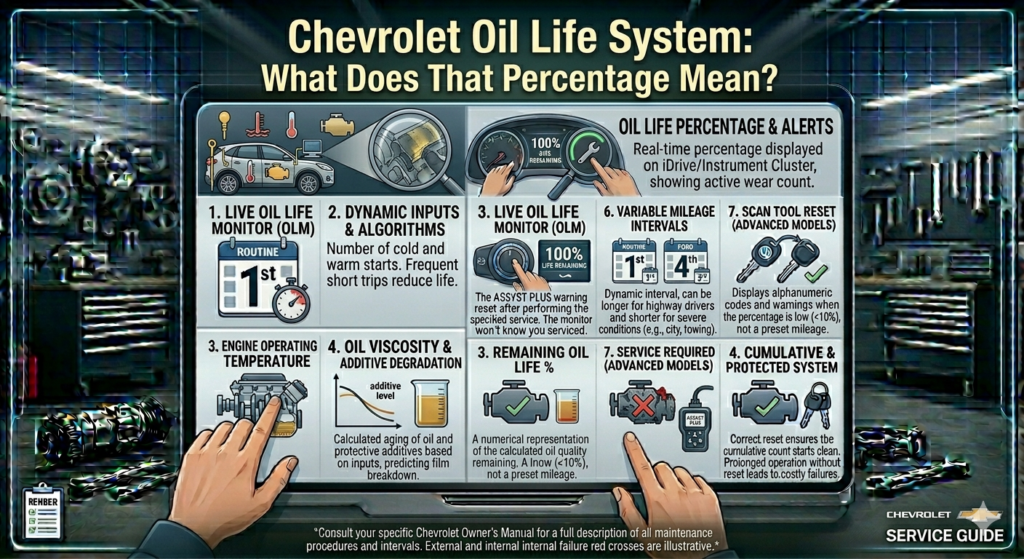
The system tracks every single engine revolution. However, not all revolutions are created equal. The OLS applies “penalty factors” based on:
-
Engine Temperature: If the engine never reaches its optimal operating temperature (common in short winter trips), the system “penalizes” the oil life percentage heavily due to moisture and fuel dilution.
-
Engine Load: High-load situations, such as towing or climbing steep grades, increase thermal stress on the oil molecules, causing the percentage to drop faster.
-
Idle Time: Long periods of idling are particularly hard on oil because there is no airflow to cool the engine, and combustion is less efficient. The OLS tracks “engine hours” to ensure you don’t exceed the oil’s limits while stuck in traffic.
1. The Dexos Standard: Why It’s Mandatory
Chevrolet Oil Life System. You cannot discuss a Chevrolet oil change without mentioning Dexos. Developed by GM engineers, Dexos is a proprietary global oil specification that goes beyond standard API (American Petroleum Institute) requirements.
-
Dexos1™ Gen 3: This is the latest standard for gasoline engines. It is specifically formulated to combat Low-Speed Pre-Ignition (LSPI)—a phenomenon in small, turbocharged engines that can literally shatter a piston under high load.
-
Turbocharger Protection: Many modern Chevrolets (like the Malibu or Trax) use small, high-heat turbochargers. Dexos oil is engineered to resist “coking,” which is when oil bakes onto the turbo bearings and blocks lubrication.
-
Timing Chain Longevity: GM engines are sensitive to timing chain “stretch.” Dexos oil contains advanced anti-wear additives that keep the chain and its hydraulic tensioner functioning smoothly. Using non-Dexos oil can lead to a “stretched” chain, causing a Check Engine Light and expensive timing repairs.
2. Understanding the Warning Thresholds
Chevrolet Oil Life System. Your Chevrolet won’t just surprise you with a dead engine; it gives you three distinct stages of warning:
-
Percentage Countdown: You can monitor this at any time in the “Vehicle Information” menu. It starts at 100% and slowly declines.
-
“Change Engine Oil Soon”: This message typically triggers when the oil life reaches 15% to 5%. You should plan to service the vehicle within the next 600 miles.
-
“Oil Change Required”: This appears at 0%. The additives in your oil are likely depleted, and the oil can no longer adequately protect against friction and acid buildup.
3. Resetting the Chevrolet Oil Life Monitor
Chevrolet Oil Life System. If you change your oil yourself or use an independent shop, you must reset the OLS manually. There are two primary methods:
Method A: The Driver Information Center (DIC)
On newer models (2014+), use the steering wheel buttons:
-
Turn the ignition to ON (Engine OFF).
-
Navigate to the “Info” or “i” menu.
-
Scroll until you find “Oil Life.”
-
Press and hold the “Checkmark” or “Reset” button (or the scroll wheel) until it returns to 100%.
Method B: The “Gas Pedal” Trick (Older Models)
For many Silverados and Impalas (pre-2014) or vehicles without a screen:
-
Turn the ignition to ON (Engine OFF).
-
Fully depress and release the accelerator pedal three times within five seconds.
-
The “Change Oil” light should flash and then turn off, indicating a successful reset.
Chevrolet Maintenance Summary Table
| Driving Condition | Expected Change Interval | Key OLS Factor |
| Ideal (Highway) | 7,500 – 10,000 Miles | Stable temperatures and high speeds. |
| Severe (City/Cold) | 3,000 – 5,000 Miles | Frequent starts and low operating temps. |
| Extreme (Towing) | < 3,000 Miles | High engine load and thermal stress. |
| Time-Based | 1 Year (Maximum) | Oil oxidizes even if you don’t drive. |
The “One Year” Rule
Chevrolet Oil Life System. Even if the OLS says you have 50% life left, GM recommends changing your oil at least once every 12 months. Oil is organic; it reacts with oxygen and moisture even while the car is parked. If you only drive your Corvette on the weekends and put on 1,000 miles a year, the “Time” factor becomes more important than the “Mileage” factor.
Conclusion: Data-Driven Engine Protection
Chevrolet Oil Life System. The Chevrolet Oil Life Monitoring System is a sophisticated tool that takes the guesswork out of maintenance. It respects the fact that a mile driven in a snowstorm while towing is different from a mile driven on a sunny highway.
By using Dexos-approved synthetic oil and respecting the OLS percentage, you are ensuring that your Chevy’s engine remains clean, efficient, and powerful for the long haul. Don’t wait for 0%—be proactive, trust the algorithm, and keep your Chevrolet running as it was engineered to.