Hyundai and Kia: Oil Pressure Warning vs. Service Light
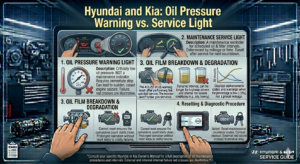
Hyundai and Kia Oil Warning vs Service Light. If you drive a Hyundai Elantra, Kia Sportage, or a Sorrento, you are likely familiar with the various icons that can appear on your dashboard. However, there are two specific red and orange lights that owners frequently confuse, and misunderstanding them can lead to a catastrophic engine failure costing thousands of dollars. The “Service Required” message and the “Red Oil Can” (Oil Pressure Warning) symbolize two completely different mechanical states.
In this technical guide, we will break down the crucial differences between a maintenance reminder and a pressure failure, explore the common issues with Theta II and Nu engines, and explain why your reaction to these lights dictates the survival of your vehicle.
1. The Service Required Light (The Orange/Yellow Reminder)
Hyundai and Kia Oil Warning vs Service Light. The “Service Required” light is the digital equivalent of a calendar. It is a proactive, software-based countdown managed by the vehicle’s cluster.
-
The Logic: It counts down from a pre-set mileage (typically 5,000 or 7,500 miles) or time (6 to 12 months).
-
The Meaning: It signifies that your oil has likely reached its chemical expiration. The additives that prevent foam, neutralize acid, and maintain viscosity are depleted.
-
The Action: You should schedule an oil change within the next few hundred miles. You can continue driving safely to your destination.
2. The Oil Pressure Warning (The Red Oil Can)
Hyundai and Kia Oil Warning vs Service Light. This is the most dangerous light on your dashboard. Unlike the service reminder, this light is triggered by a physical sensor (the oil pressure switch) that detects a drop in hydraulic pressure inside the engine block.
-
The Logic: If the oil pressure drops below a critical threshold (usually 5–7 PSI at idle), the sensor completes a circuit and triggers the red light immediately.
-
The Meaning: Your engine is no longer being lubricated. Metal is rubbing against metal at thousands of revolutions per minute. Within seconds, the heat generated by this friction can weld the bearings to the crankshaft.
-
The Action: STOP IMMEDIATELY. You must pull over, turn off the engine, and check the oil level. If the oil is full but the light is red, do not restart the car—call a tow truck.
3. The Hyundai/Kia Technical Context: Theta II and Nu Engines
Hyundai and Kia Oil Warning vs Service Light. Hyundai and Kia engines, particularly the 2.0L and 2.4L GDI (Gasoline Direct Injection) units, have faced scrutiny regarding oil management. Understanding the “Red Light” is vital for these specific engines.
-
Metal Debris and Clogged Orifices: In some manufacturing batches, metallic debris from the machining process could block the tiny oil passages. If this happens, the oil pump cannot push enough fluid to the top of the engine, triggering the Red Oil Pressure light.
-
Oil Consumption Issues: Some “Nu” and “Theta” engines are known to consume oil at a higher rate than average. If the oil level drops too low, the pump will eventually suck in air instead of oil, causing a sudden loss of pressure and the red warning light.
4. Why Pressure Fails: Beyond Low Oil Levels
Hyundai and Kia Oil Warning vs Service Light. Sometimes the red light comes on even if your dipstick shows the oil is full. This indicates a mechanical failure in the lubrication system:
-
Faulty Oil Pump: The mechanical pump responsible for circulating oil has failed or its drive chain has snapped.
-
Clogged Oil Pickup Screen: Sludge buildup (caused by ignoring the Service Required light for too long) can coat the mesh screen in the oil pan, preventing the pump from drawing oil.
-
Oil Pressure Sensor Failure: Occasionally, the sensor itself fails and gives a false reading. However, as a technician, you must always assume the light is telling the truth until proven otherwise by a mechanical pressure gauge.
5. Summary: Red Light vs. Service Message
| Feature | Service Required Light | Oil Pressure Warning |
| Color | Orange / Yellow / Text | Red (Oil Can Icon) |
| Trigger | Mileage / Time Counter | Real-time Pressure Sensor |
| Urgency | Low (Plan a visit) | Critical (Stop Immediately) |
| Risk | Gradual wear / Sludge | Total Engine Seizure |
| Common Cause | Reaching 5,000 miles | Low oil level or pump failure |
6. How to Reset the Service Reminder (Not the Red Light!)
Hyundai and Kia Oil Warning vs Service Light. You can reset the maintenance interval yourself, but you cannot “reset” a red oil pressure light—that requires a mechanical repair. To reset the reminder in most modern Hyundai and Kia vehicles:
-
Turn the ignition ON (Engine OFF).
-
Press the “Mode” button (Documents icon) on the steering wheel to reach the “User Settings” menu.
-
Scroll down to “Service Interval.”
-
Press and hold the “OK” or “Reset” button for more than 5 seconds.
-
When it asks to confirm, press OK again.
7. The Critical Role of the OEM Oil Filter
Hyundai and Kia Oil Warning vs Service Light. A common technical cause for oil pressure fluctuations in Hyundai and Kia vehicles is the use of poor-quality, aftermarket oil filters.
-
The Bypass Valve: Genuine Hyundai/Kia filters are designed with specific bypass valve spring tensions.
-
The Anti-Drainback Valve: Aftermarket filters often have weaker valves that allow oil to drain back into the pan when the car is off. This leads to a “dry start” where the red oil light stays on for 2-3 seconds every morning, causing cumulative damage to the engine bearings.
Pro Tip: Always use a genuine OEM filter (e.g., Part No. 26300-35505) to ensure stable oil pressure.
Conclusion: One is a Reminder, One is an Emergency
Hyundai and Kia Oil Warning vs Service Light. For a Hyundai or Kia owner, the difference between these two lights is the difference between a $70 oil change and a $7,000 engine replacement. The orange “Service Required” light is a helpful assistant reminding you to maintain your vehicle. The red “Oil Pressure” light is a desperate scream for help from your engine’s internal components.
Never ignore the red light, even for a few blocks. If you see it, pull over safely and save your engine. By respecting the maintenance intervals and reacting correctly to pressure warnings, you can keep your Hyundai or Kia on the road for many years to come.