Mercedes ASSYST PLUS Decoding Service A and Service B Codes
Mercedes Decoding Service A and Service B Codes. For generations, the three-pointed star has symbolized automotive luxury and rigorous engineering. To maintain the “Best or Nothing” standard, Mercedes-Benz developed the Active Service System Plus (ASSYST PLUS). This onboard logic center moves beyond simple mileage tracking to provide a tailored maintenance schedule for your specific vehicle. When your instrument cluster displays “Service A Due” or “Service B Exceeded by 10 Days,” it is communicating a specific set of technical requirements designed to preserve the performance of your engine and transmission.
In this technical guide, we will decode the ASSYST PLUS system, explain the fundamental differences between Service A and Service B, and discuss why specialized Mercedes-Benz oil specifications (MB-Approval) are non-negotiable for turbocharged and BlueTEC diesel engines.
How ASSYST PLUS Operates: The Intelligence Behind the Star
The ASSYST PLUS system is a dynamic monitoring suite. It tracks the number of cold starts, average engine speeds, oil temperature cycles, and even fuel consumption levels.
Mercedes Decoding Service A and Service B Codes. Unlike a static 5,000-mile timer, the Mercedes system might call for service at 8,000 miles if you drive primarily in heavy city traffic, or extend the interval to 12,000 miles if you spend your time cruising on the highway at stable temperatures. The goal is to ensure that the additives in your motor oil haven’t been depleted by “Severe Service” conditions before the next scheduled change.
1. Service A vs. Service B: The Core Differences
Mercedes-Benz maintenance follows an alternating pattern. Generally, you will encounter Service A first, followed by Service B approximately one year or 10,000 miles later.
Service A (The Minor Service)
Mercedes Decoding Service A and Service B Codes. Service A is the “Introductory” maintenance level. It typically occurs after the first year or 10,000 miles. It includes:
-
Synthetic Motor Oil Replacement: Using MB-Approved high-performance oil.
-
Oil Filter Replacement: Utilizing fleece or high-efficiency synthetic media filters.
-
Fluid Level Checks: Including coolant, brake fluid, and power steering (if applicable).
-
Tire Inflation Check: Ensuring the TPMS (Tire Pressure Monitoring System) is calibrated.
-
Brake Component Inspection: A visual check of pads and rotors for wear.
Service B (The Major Service)
Mercedes Decoding Service A and Service B Codes. Service B is more comprehensive and usually occurs every 20,000 miles or 2 years. In addition to everything in Service A, it mandates:
-
Cabin Air Filter Replacement: To ensure the interior air quality and HVAC efficiency.
-
Brake Fluid Exchange: Mercedes-Benz is strict about replacing brake fluid every two years to prevent moisture-induced corrosion in the ABS/ESP pump.
-
Detailed Multi-Point Inspection: A deeper look at the suspension bushings, drive belts, and steering linkages.
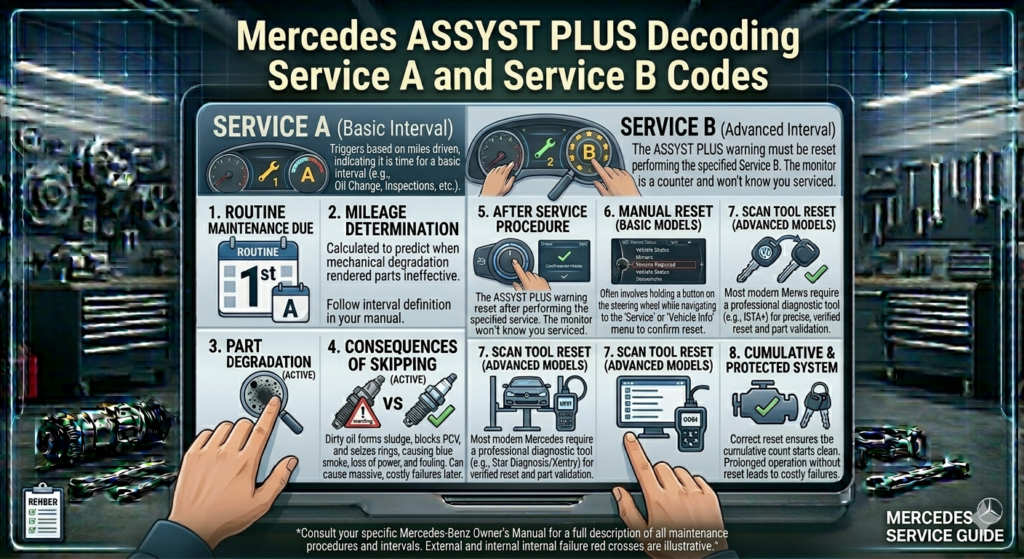
2. Understanding the Sub-Numbers (Service A3, B5, etc.)
Mercedes Decoding Service A and Service B Codes. You may notice a number following the letter on your dashboard (e.g., Service B3). These numbers indicate additional “Required Items” based on time and mileage intervals:
-
Number 1: Often indicates a tire rotation.
-
Number 3: Usually triggers a transmission oil and filter change (Critical for 7G and 9G-Tronic gearboxes).
-
Number 5: Can indicate an engine air filter or spark plug replacement.
-
Number 8/9: Often refers to fuel filter replacement (especially on Diesel/BlueTEC models).
3. The “MB-Approval” Oil Standard: Why It Matters
Mercedes Decoding Service A and Service B Codes. Mercedes-Benz engines, particularly the high-compression AMG units and the BlueTEC diesels, require oil that meets specific Operating Fluids (Betriebsstoffe) standards.
-
MB 229.5: The standard for most modern gasoline engines. It is designed for long-drain intervals and high thermal stability.
-
MB 229.51 / 229.52: Specifically for Diesel engines with DPFs (Diesel Particulate Filters). Using “standard” oil in these engines will clog the DPF with ash, leading to a multi-thousand dollar repair.
-
MB 229.71: The newest ultra-low viscosity (0W-20) standard for the latest M264 and M256 engines.
The ASSYST PLUS system “assumes” you are using these high-tier oils. If you use a lower-quality lubricant, the oil will degrade chemically long before the computer triggers the “Service Due” light, leading to internal sludge and timing chain stretch.
4. Impact on the 7G and 9G-Tronic Transmissions
Mercedes Decoding Service A and Service B Codes. Many Mercedes-Benz models integrate transmission health into the ASSYST PLUS reminders. The 7G-Tronic and 9G-Tronic transmissions are highly sensitive to fluid cleanliness.
If the service light (specifically Sub-code 3) is ignored, the microscopic metallic wear from the clutches can clog the “Conductor Plate” or the “Valve Body.” This results in harsh shifting, gear slipping, and eventually, the transmission entering “Limp Home Mode.” Timely response to the service light ensures these expensive transmission components remain lubricated and cool.
5. How to Reset the Service Light (The Steering Wheel “Secret”)
Mercedes Decoding Service A and Service B Codes. While it varies by generation, most modern Mercedes (W205, W213, W222) require a specific “hidden menu” sequence to reset the ASSYST PLUS:
-
Close all doors and turn the ignition to Position 1.
-
Navigate the steering wheel menu to the “Trip” or “Odometer” screen.
-
Press and hold the “Call” button and the “OK” button simultaneously for 5 seconds.
-
The “Vehicle Data” or “Workshop” menu will appear.
-
Select “ASSYST PLUS” and then “Full Service” to confirm and reset the light.
Mercedes-Benz Maintenance Overview Table
| Service Type | Typical Interval | Critical Focus Area |
| Service A | 10k Miles / 1 Year | Engine Lubrication & Safety Check. |
| Service B | 20k Miles / 2 Years | Filtration & Brake System Health. |
| Transmission Service | 40k – 60k Miles | 7G/9G-Tronic Fluid & Filter Swap. |
| Spark Plugs | 50k – 80k Miles | Ignition Efficiency & Coil Protection. |
The “BlueTEC” Factor for Diesel Owners
If you drive a Mercedes diesel, the ASSYST PLUS system also monitors your AdBlue (DEF) levels. If you ignore the “Service Due” light and the AdBlue runs low, the vehicle will eventually enter a “No Start” condition after a specific number of engine cycles. The service light is your early warning to replenish the DEF and ensure the emissions system is functioning correctly to avoid expensive sensors failing.
Conclusion: Proactive Luxury Maintenance
Mercedes Decoding Service A and Service B Codes. A Mercedes-Benz is more than a car; it is a complex network of sensors and mechanical components designed to work in perfect harmony. The ASSYST PLUS system is the conductor of that harmony. By understanding the difference between Service A and Service B, and respecting the specific sub-codes and oil requirements, you are ensuring that your vehicle delivers the safety and performance it was engineered for.
An investment in timely service is the only way to protect the high resale value and mechanical integrity of your Mercedes-Benz. When the star on your dash tells you it’s time for service, listen—it’s the best way to keep your journey smooth for years to come.