Volkswagen Service Now Warning: Resetting and Meaning Explained
Volkswagen Service Now Warning Explained. If you own a Volkswagen or an Audi, you have likely encountered the persistent “Service Now” or “Service Due” message on your multi-function display. Unlike many other manufacturers that use simple countdowns, the Volkswagen Group (VAG) employs a sophisticated maintenance monitoring system that distinguishes between a simple oil change and a comprehensive vehicle inspection. In a German-engineered machine where tolerances are incredibly tight, this warning is not just a suggestion—it is a critical synchronization between the vehicle’s hardware and its operating software.
In this technical guide, we will break down what the “Service Now” warning actually means, the difference between fixed and flexible service intervals, and why using the correct VW-specification oil is the only way to keep your turbocharged engine healthy.
Understanding the VAG Service Logic: Oil vs. Inspection
Volkswagen vehicles typically track two separate maintenance requirements simultaneously. This is why you might see a “Service Now” light only 2,000 miles after your last oil change. Volkswagen Service Now Warning Explained.
-
Oil Change Service: This is focused strictly on the engine’s lubrication. It monitors mileage and time (and in some models, driving style) to ensure the oil hasn’t oxidized or sheared down.
-
Inspection Service: This is a much broader check. It includes the braking system, suspension, battery health, sunroof drains, and electronic diagnostic scans.
When the “Service Now” light appears, it is often triggered by whichever of these two requirements comes first. If you only reset the “Oil Life” but the “Inspection” interval is still active, the light will reappear almost immediately.
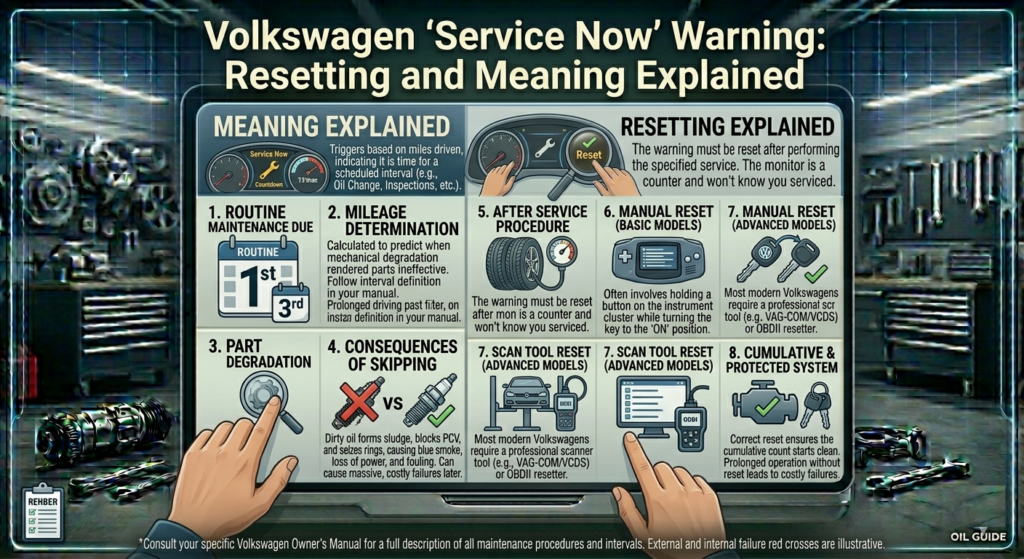
1. Fixed vs. Flexible Service Intervals
Volkswagen Service Now Warning Explained. One of the unique features of Volkswagen and Audi vehicles is the ability to toggle between two different service philosophies, depending on the market and the oil quality used.
The Fixed Interval (Time/Distance)
This is the standard for most drivers in North America and many parts of Asia. The car is programmed to trigger a “Service Now” alert every 10,000 miles (15,000 km) or 12 months, whichever comes first. This is a rigid countdown that does not account for how you drive.
The Flexible Interval (LongLife Service)
Volkswagen Service Now Warning Explained. Common in Europe, this system uses sensors to monitor oil level, oil temperature, and even the electrical conductivity of the oil to estimate soot loading. Under ideal highway conditions, a VW using LongLife oil can theoretically go up to 18,000 miles (30,000 km) or 24 months before the “Service Now” light appears. However, if you do frequent cold starts or heavy city driving, the computer will automatically shorten this interval to protect the engine.
2. The Critical Role of VW Oil Specifications
Volkswagen Service Now Warning Explained. You cannot simply put “any” synthetic oil into a Volkswagen or Audi. Doing so is the fastest way to trigger a premature “Service Now” warning or, worse, mechanical failure. VW engines are designed around very specific chemical formulations.
-
VW 502.00 / 505.00: The older standard for many gasoline engines.
-
VW 504.00 / 507.00: The modern “LongLife” standard required for most turbocharged (TSI/TFSI) and diesel (TDI) engines.
-
VW 508.00 / 509.00: The newest ultra-low viscosity (0W-20) standard designed for maximum fuel efficiency in late-model engines.
Using oil that lacks these specific approvals can lead to Carbon Buildup on the intake valves—a common and expensive issue in Direct Injection engines. The “Service Now” interval is calculated based on the assumption that you are using these high-spec oils.
3. The Hidden Dangers of Ignoring the Warning
Volkswagen Service Now Warning Explained. Ignoring a “Service Now” light in a Volkswagen is riskier than in many other brands due to the complexity of the German valvetrain.
-
Timing Chain Tensioners: Many VW engines use hydraulic timing chain tensioners that rely on consistent oil pressure and cleanliness. Old, thinned-out oil can cause the tensioner to fail, leading to the timing chain skipping a tooth and potentially destroying the entire engine.
-
Turbocharger Bearing Wear: Turbos in Audi and VW vehicles spin at over 150,000 RPM and are cooled by engine oil. When the “Service Now” light is ignored, the accumulated carbon in the oil can “coke” (harden) inside the turbo’s small oil lines, leading to a total turbocharger failure.
-
DPF Clogging (TDI Models): For diesel owners, the “Service Now” light is critical for the Diesel Particulate Filter (DPF). If the oil is too old, the engine cannot perform proper “regeneration” cycles, leading to a clogged filter that costs thousands of dollars to replace.
4. How to Reset the “Service Now” Light
Volkswagen Service Now Warning Explained. The reset procedure for VAG vehicles has evolved significantly over the years. Depending on your model year, you will likely use one of these three methods:
-
The Steering Wheel / Dashboard Method (2010–2018): Usually involves holding the “0.0/SET” button while turning the ignition on, then pressing the “Menu” or “OK” button on the steering wheel.
-
The Infotainment Screen (2019+): In newer models like the Golf Mk8 or Audi A4 (B9), you must navigate to the “Vehicle” menu, then “Settings & Service,” and finally “Service Interval.” From there, you can see exactly how many days are left and perform a reset.
-
The OBD-II / VCDS Method: For a “Full Inspection” reset, many Volkswagens require a diagnostic tool like VCDS (Ross-Tech) or an OBD-Eleven device. A manual dashboard reset often only clears the oil reminder, not the inspection reminder.
Volkswagen Service Interval Summary Table
| Driving Condition | Recommended Service | Interval Limit |
| Normal (Highway) | Oil & Filter Change | 10,000 Miles / 1 Year |
| Severe (City/Towing) | Oil & Filter Change | 5,000 Miles / 6 Months |
| Major Service | Full Inspection & Filters | Every 20,000 Miles |
| Brake Fluid | Flush and Replace | Every 2 Years (Regardless of miles) |
The “Direct Injection” Factor
Volkswagen Service Now Warning Explained. Because most VW and Audi engines are GDI (Gasoline Direct Injection), they are prone to fuel dilution in the oil. This means gasoline can seep past the rings and thin out the oil. If you notice a “Service Now” light appearing earlier than expected, your car’s sensors may have detected that the oil’s viscosity has been compromised by fuel. Never ignore an early warning in a GDI engine; it is the computer’s way of preventing internal “washing” of the cylinder walls.
Conclusion: Precision Maintenance for Precision Machines
Volkswagen Service Now Warning Explained. The “Service Now” warning in a Volkswagen or Audi is a sophisticated tool designed to help you maintain the high-performance standards of German engineering. It is not an arbitrary timer; it is a calculated safeguard against the unique wear patterns of turbocharged, direct-injected engines.
By using only VW-approved oils and ensuring that both the Oil and Inspection resets are performed correctly, you are protecting the turbocharger, the timing system, and the overall longevity of your vehicle. A Volkswagen that is serviced “by the book” can easily provide a lifetime of driving pleasure.