Motor Oil Selection Guide: Full Synthetic vs. Semi-Synthetic Differences
Motor Oil Selection Guide. Choosing the right motor oil is more than just a routine maintenance task; it is the single most important factor in determining your engine’s lifespan. With various options on the shelf, the debate between Full Synthetic and Semi-Synthetic (Synthetic Blend) oils often leaves car owners confused.
In this guide, we will break down the chemical differences, performance benefits, and cost-efficiency of each to help you make an informed decision for your vehicle.
What is Full Synthetic Motor Oil?
Motor Oil Selection Guide. Full synthetic oil is a highly refined lubricant manufactured in a laboratory environment. Unlike conventional oils, it is not just “refined” from crude oil; its molecular structure is broken down and rebuilt to be uniform.
-
Uniformity: All molecules are the same size, which significantly reduces internal friction.
-
Purity: It contains fewer impurities, reducing the risk of engine sludge and deposits.
-
Stability: It maintains its viscosity (thickness) across a wide range of temperatures.
What is Semi-Synthetic (Synthetic Blend) Oil?
Motor Oil Selection Guide. Semi-synthetic oil is a mixture of synthetic and conventional mineral oils. It is designed to provide some of the benefits of synthetic technology at a price point closer to traditional oil.
-
Balance: It offers better protection than conventional oil but lacks the extreme performance of a full synthetic.
-
Transition: It is often used as a stepping stone for older vehicles that require more protection than mineral oil but don’t necessarily need the high cost of full synthetic.
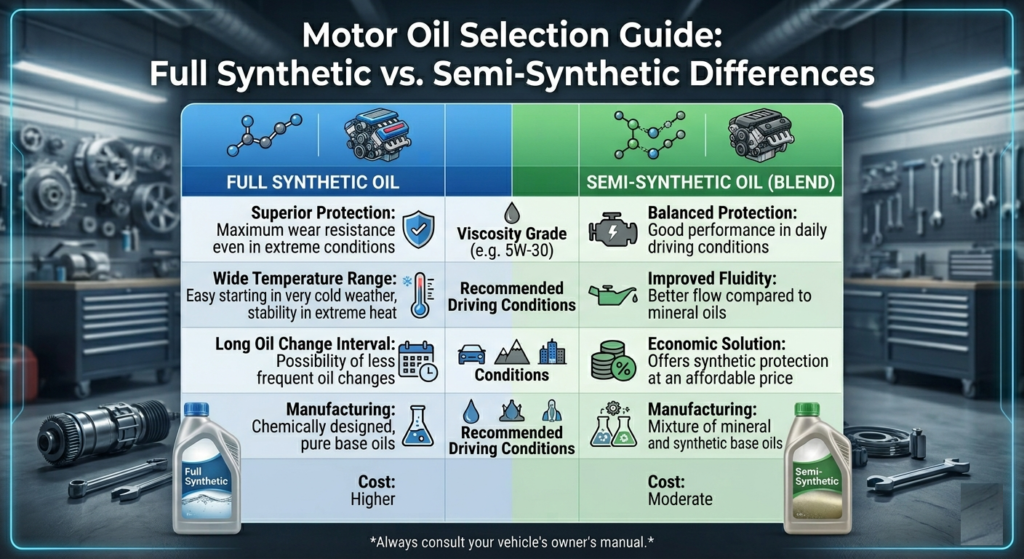
Key Differences: Performance and Protection
| Feature | Full Synthetic Oil | Semi-Synthetic Oil |
| Engine Protection | Maximum protection against wear. | Improved protection over mineral oil. |
| Temperature Stability | Excellent in extreme heat/cold. | Moderate stability. |
| Oil Change Interval | Typically 10,000 to 15,000 miles. | Typically 5,000 to 7,500 miles. |
| Cost | Higher upfront cost. | Budget-friendly. |
| Sludge Prevention | High resistance to deposits. | Moderate resistance. |
Which One Should You Choose?
The decision usually comes down to three main factors: your vehicle’s requirements, your driving habits, and your budget.
1. Check Your Owner’s Manual
Always start with the manufacturer’s recommendation. If your car requires 0W-20 or 5W-20, it likely mandates full synthetic oil. Using a lower-grade blend in a high-performance or turbocharged engine can lead to premature wear.
2. Consider Your Driving Conditions
-
Extreme Weather: If you live in a region with freezing winters or scorching summers, Full Synthetic is the winner because it flows better in the cold and doesn’t break down in the heat.
-
Stop-and-Go Traffic: City driving is hard on engines. Full synthetic provides better protection during frequent starts and idles.
-
Towing or Heavy Loads: If you use your vehicle for hauling, the added film strength of full synthetic is essential.
3. The Budget Factor
Motor Oil Selection Guide. While full synthetic is more expensive per quart, it lasts longer. If you factor in the extended oil change intervals, full synthetic often ends up being more cost-effective over a 12-month period.
Conclusion
Motor Oil Selection Guide. While Semi-Synthetic oil is a valid option for many older or budget-conscious drivers, Full Synthetic remains the gold standard for modern engine protection. By investing in a high-quality lubricant today, you are preventing thousands of dollars in potential engine repairs tomorrow.
Pro Tip: Never mix different brands or types of oil unless it’s an emergency. Maintaining a consistent chemical balance is key to optimal engine health.