New Car Oil Changes: Why Your First Break-In Oil Is Critical
New Car Oil Changes. Buying a brand-new vehicle is a significant investment, and the first few thousand miles are arguably the most important in the engine’s entire lifespan. This period, known as the “break-in” or “run-in” phase, is when the internal components of the engine—pistons, rings, camshafts, and bearings—literally “get to know” each other. While modern manufacturing has become incredibly precise, the role of the very first oil that comes from the factory, often called Break-In Oil, remains a subject of intense technical debate and critical importance.
In this comprehensive guide, we will explore the science behind engine break-in, the unique chemical composition of factory-fill oil, and why the timing of your very first oil change can dictate your vehicle’s performance and reliability for the next decade.
What Exactly Is “Break-In Oil”?
New Car Oil Changes. Contrary to popular belief, the oil inside a brand-new car’s engine isn’t always the standard synthetic oil you buy off the shelf. Many manufacturers use a specialized “break-in oil” that is chemically formulated to facilitate the seating of engine components.
Unlike standard lubricants designed to minimize friction as much as possible, break-in oil often contains specific additives like Zinc and Phosphorus (ZDDP) and a different base stock that allows for a controlled amount of “sacrificial wear.” This controlled friction is necessary to allow the piston rings to “scrub” against the cylinder walls, creating a perfect, airtight seal. Without this initial wear, the rings may never seat properly, leading to a lifetime of oil consumption and reduced compression.
1. The Reality of Manufacturing Debris
New Car Oil Changes. Even in the most advanced robotic factories, the process of casting and machining an engine block is not perfect. When a new engine is first fired up, there are microscopic “burrs” and tiny metal fragments left over from the honing process.
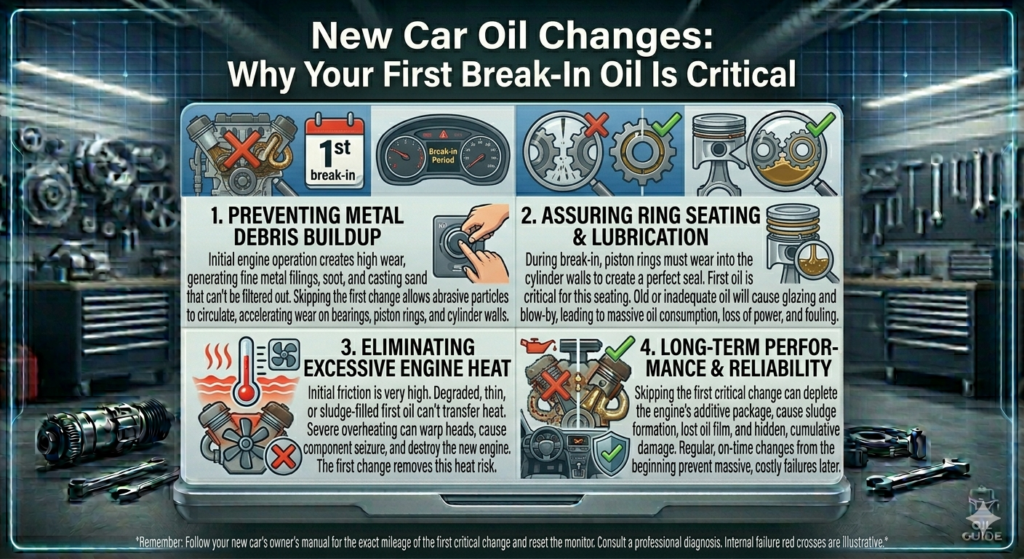
As the pistons move up and down during the first few hundred miles, they act like a file, smoothing out the microscopic ridges on the cylinder walls. This process releases fine metallic particulate matter into the oil. While the oil filter is designed to catch most of this, the concentration of metal “dust” in the first 1,000 miles is significantly higher than at any other time in the car’s life. Removing this “glitter” from your engine as soon as the break-in process is complete is essential to prevent it from acting as an abrasive in your bearings.
2. Piston Ring Seating: The Window of Opportunity
New Car Oil Changes. The most critical task during the break-in period is seating the piston rings. The cylinder walls of a new engine have a “cross-hatch” pattern—tiny scratches created by a honing tool. The piston rings must rub against these scratches to wear into a shape that perfectly matches the cylinder’s diameter.
If you change the factory oil too early (e.g., at 100 miles) and replace it with a high-performance, low-friction synthetic oil, you might stop the break-in process too soon. Conversely, if you leave the break-in oil in for too long (e.g., 10,000 miles), the metal particles mentioned earlier can begin to score the very surfaces you are trying to smooth out. Most automotive enthusiasts and master technicians recommend a “middle ground” first change between 1,000 and 1,500 miles.
3. The Impact of Modern “Tight” Tolerances
New Car Oil Changes. One of the most common arguments against early first oil changes is that “modern engines are built with tighter tolerances.” While it is true that a 2026 engine is more precise than one from 1980, this actually makes the oil’s job more difficult, not easier.
In a modern engine, the gaps between the crankshaft and the bearings are thinner than a human hair. Because these tolerances are so tight, even microscopic debris from the manufacturing process can cause significant damage if it gets caught in a high-pressure oil gallery. In a “loose” old engine, a tiny metal shaving might pass through harmlessly; in a modern high-compression engine, it can cause a “hot spot” or localized scoring almost instantly.
4. Why Manufacturers Recommend Long Intervals
New Car Oil Changes. If you check your owner’s manual, you might see a recommendation to wait until 7,500 or even 10,000 miles for the first oil change. This often conflicts with the advice of mechanics. There are two main reasons for these long factory recommendations:
-
Environmental Regulations: Manufacturers are under immense pressure to reduce the “environmental footprint” of their vehicles. Fewer oil changes mean less waste oil.
-
Cost of Ownership Ratings: Lower maintenance requirements make a car look “cheaper to own” in consumer reports and marketing materials.
However, “minimum requirements” for a lease period are different from “best practices” for a car you plan to keep for 200,000 miles. Performing that first change early is a low-cost insurance policy for the long-term health of the engine.
5. Symptoms to Monitor During the First 3,000 Miles
New Car Oil Changes. During the break-in period, your vehicle may behave differently than it will in its “mature” state. It is important to watch for:
-
Slightly Higher Oil Consumption: It is normal for a new engine to “eat” a little bit of oil while the rings are seating. Check your dipstick every 500 miles during the first 3,000.
-
Distinct Smells: You may smell “burning” odors as manufacturing oils and coatings on the exterior of the engine block and exhaust heat up for the first time.
-
Metallic “Glitter” on the Dipstick: If you see large flakes, that is a problem. If the oil looks slightly “shimmery” or metallic in the sunlight, that is the normal shedding of break-in debris.
The Successful Break-In Strategy
New Car Oil Changes. To ensure your engine lasts as long as possible, follow this “Best Practice” schedule for a new vehicle:
-
0 – 1,000 Miles: Vary your speeds. Avoid using cruise control. Do not “redline” the engine, but also do not drive too slowly. The engine needs varying pressure to seat the rings.
-
1,000 – 1,500 Miles: Perform the first oil and filter change. This removes the manufacturing debris and the initial “wear-in” metals.
-
1,500 – 5,000 Miles: Switch to your preferred high-quality full synthetic oil and follow a regular 5,000-mile interval thereafter.
Conclusion: The Foundation of Engine Health
New Car Oil Changes. The first oil change is the most important one you will ever perform. By removing the microscopic metal shavings and “polishing paste” created during the initial break-in period, you are protecting the precision-engineered surfaces of your new engine. While it might seem like an unnecessary expense when the dealership says you can wait 10,000 miles, the peace of mind and mechanical reliability gained from an early first change are worth every penny.
A new car is a fresh start. Treat its first few thousand miles with respect, and the engine will return the favor with hundreds of thousands of miles of smooth, efficient performance.