Oil Change Intervals: Mileage vs Time Limits Explained
Oil Change Intervals Mileage vs Time Limits. One of the most persistent debates in the automotive world centers on a seemingly simple question: Should you change your oil based on how far you have driven, or how long the oil has been sitting in your engine? While the “3,000-mile or 3-month” rule was the gold standard for decades, modern synthetic lubricants and advanced engine engineering have completely shifted the goalposts. Today, car owners are often caught between manufacturer recommendations of 10,000 miles and the warnings of mechanics who insist on more frequent intervals.
In this comprehensive technical guide, we will break down the science of oil degradation. We will explore why “time” is sometimes a more aggressive enemy than “mileage,” the hidden dangers of low-mileage driving, and how to determine the perfect service interval for your specific vehicle and driving habits.
The Two Forces of Degradation: Mechanical vs. Chemical
Oil Change Intervals: Mileage vs Time Limits. To understand the interval debate, you must first understand that motor oil does not just “wear out”—it breaks down through two distinct processes.
1. Mechanical Breakdown (Mileage-Dependent)
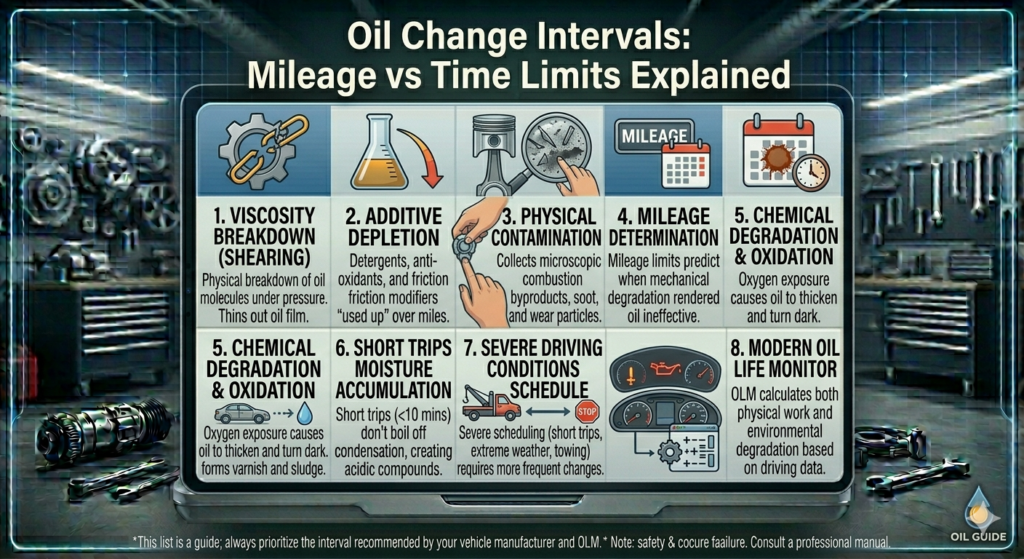
Oil Change Intervals: Mileage vs Time Limits. As you drive, the oil is subjected to immense physical stress. It is pumped through tight galleries, squeezed between high-speed bearings, and splashed against scorching-hot cylinder walls. Over thousands of miles, the long-chain polymer molecules in the oil (viscosity index improvers) begin to “shear” or break apart. This causes the oil to lose its ability to maintain a consistent thickness, eventually becoming too thin to protect the engine during high-heat operation.
2. Chemical Breakdown (Time-Dependent)
Oil Change Intervals: Mileage vs Time Limits. Even if your car is parked in a climate-controlled garage, the oil is undergoing a process called Oxidation. When oil is exposed to oxygen, it begins to break down chemically, regardless of whether the engine is running. Over time, oxidation leads to an increase in oil viscosity (it becomes thick and sludgy) and the formation of organic acids that can corrode internal engine seals and soft metal bearings.
The “Short Trip” Paradox: Why Driving Less Is Harder on Oil
Oil Change Intervals: Mileage vs Time Limits. Many drivers believe that because they only drive 2,000 miles a year, they can wait two or three years between oil changes. This is a dangerous misconception. In fact, low-mileage, “city-only” driving is often classified as “Severe Service” by manufacturers.
When you start an engine, moisture from the air and unburned fuel from the combustion process leak into the oil pan (this is known as blow-by). On a long highway drive, the oil reaches its full operating temperature (about 212°F), which allows that moisture and fuel to evaporate and be cleaned out by the PCV system.
However, on short trips—such as a 5-minute drive to the grocery store—the oil never gets hot enough to boil off these contaminants. The water and fuel stay in the oil pan, mixing with the lubricant to form a milky, acidic sludge. This is why the “Time” limit (typically 6 to 12 months) is non-negotiable for low-mileage drivers.
Factor 1: The Role of Modern Synthetic Chemistry
Oil Change Intervals: Mileage vs Time Limits. The reason we no longer change oil every 3,000 miles is due to the evolution of synthetic base oils. Unlike conventional mineral oil, synthetic oil is engineered to be highly resistant to both shearing and oxidation.
-
Mileage Advantage: High-quality synthetics can easily maintain their protective properties for 7,500 to 10,000 miles in ideal driving conditions.
-
Time Advantage: Synthetics contain advanced antioxidant additives that slow down the chemical aging process, allowing some manufacturers to approve a 12-month interval.
Factor 2: Extreme Operating Conditions
Oil Change Intervals: Mileage vs Time Limits. Most owner’s manuals provide two different schedules: “Normal” and “Severe.” It is estimated that over 70% of drivers actually fall into the “Severe” category without realizing it. You should prioritize the “Mileage” limit and shorten it significantly if you experience:
-
Extreme Temperatures: Regularly driving in temperatures above 90°F (32°C) or below 0°F (-18°C).
-
Towing and Hauling: Carrying heavy loads or trailers puts massive thermal stress on the oil.
-
Idling: If you spend hours in heavy traffic, your engine is “working” and the oil is degrading, but your odometer isn’t moving. In this case, 5,000 miles of city driving might equal 10,000 miles of engine wear.
Interval Comparison: Which Metric Should Win?
| Driving Profile | Recommended Metric | Ideal Interval |
| The Long Commuter (High Highway Miles) | Mileage | 7,500 – 10,000 Miles |
| The Weekend Driver (Low Miles/Short Trips) | Time | 6 Months / 1 Year |
| The Urban Taxi/Delivery (Heavy Idling) | Mileage (Early) | 3,000 – 5,000 Miles |
| The Performance/Track Driver | Usage/Heat | After every track event |
The “Whichever Comes First” Rule
Oil Change Intervals: Mileage vs Time Limits. The industry standard for a healthy engine is the “Whichever Comes First” rule. If your manual says “10,000 miles or 12 months,” and you reach 10,000 miles in only 4 months, you change it. If you only drive 3,000 miles but 12 months have passed, you change it.
Ignoring the time limit because “the oil still looks clean” is a mistake. The acidic buildup and additive depletion are often invisible to the naked eye but can be detected through a laboratory Used Oil Analysis (UOA). For most modern vehicles using full synthetic oil, a 6-month or 5,000-mile interval (whichever comes first) is considered the “sweet spot” for maximum engine protection and long-term reliability.
How Intelligent Oil Life Monitors (IOLM) Bridge the Gap
Oil Change Intervals: Mileage vs Time Limits. Fortunately, many modern vehicles (such as those from Ford, GM, Honda, and BMW) take the guesswork out of the equation. These systems monitor both mileage and time, but they also track engine load, temperature, and idle time.
-
If you drive primarily on the highway, the system will allow you to go closer to 10,000 miles.
-
If the car sits in the driveway for months or is used for short winter trips, the system will trigger the “Change Oil Soon” light much earlier, even if you’ve only driven 2,000 miles.
However, even with these smart systems, you should never exceed one year without a fresh oil and filter change.
Conclusion: Precision Over Guesswork
Oil Change Intervals: Mileage vs Time Limits. In the battle of Mileage vs. Time, there is no single winner—both are critical indicators of oil health. Mileage tracks the physical “work” the oil has performed, while time tracks the chemical “decay” of the lubricant. By respecting both metrics, you ensure that your engine is never forced to run on sheared-down or acidic oil.
The cost of an extra oil change per year is negligible compared to the cost of replacing turbochargers, timing chain tensioners, or entire engine blocks. When in doubt, follow the “Whichever Comes First” rule, and your vehicle will reward you with a lifetime of smooth, efficient performance.