Oil Filter Importance: 5 Risks of Using a Clogged Engine Filter
Oil Filter Importance: 5 Risks of Using a Clogged Engine Filter. While engine oil often gets all the glory in automotive maintenance discussions, its silent partner—the oil filter—plays an equally critical role in ensuring your vehicle’s longevity. Think of engine oil as the blood of your car and the oil filter as its kidneys. Without a functional filter, the “blood” becomes contaminated, leading to a slow but certain decline in engine health.
In this comprehensive guide, we will explore why the oil filter is so vital, the mechanics of how it fails, and the five specific ways a clogged filter can devastate your engine.
Understanding the Role of the Oil Filter in Modern Engines
Oil Filter Importance: 5 Risks of Using a Clogged Engine Filter. The primary job of an oil filter is to trap contaminants. As motor oil circulates through the engine, it picks up microscopic metal shavings, carbon deposits, dust, and dirt. If these particles are allowed to remain in the oil, they act like sandpaper against the precision-engineered surfaces of your engine’s internal components, such as the camshafts, pistons, and crankshaft bearings.
A high-quality oil filter is designed with a specific “micron rating.” This rating determines the size of the particles the filter can successfully trap. Most modern synthetic filters are capable of catching particles as small as 20 to 30 microns—which is thinner than a human hair. However, as the filter does its job, these trapped particles eventually saturate the filtration media, leading to a “clogged” state.
The Mechanics of Failure: What Happens When a Filter Is Full?
Before diving into the risks, it is important to understand a technical feature found in almost all modern filters: the Bypass Valve.
Oil Filter Importance: 5 Risks of Using a Clogged Engine Filter. When a filter becomes completely clogged, the oil pressure builds up because the oil can no longer pass through the saturated media. To prevent the engine from starving for oil entirely, the bypass valve opens. This allows unfiltered, dirty oil to circulate through the engine. While dirty oil is better than no oil, it means your engine is now being “lubricated” by a mixture of oil and abrasive debris. This is the moment the real damage begins.
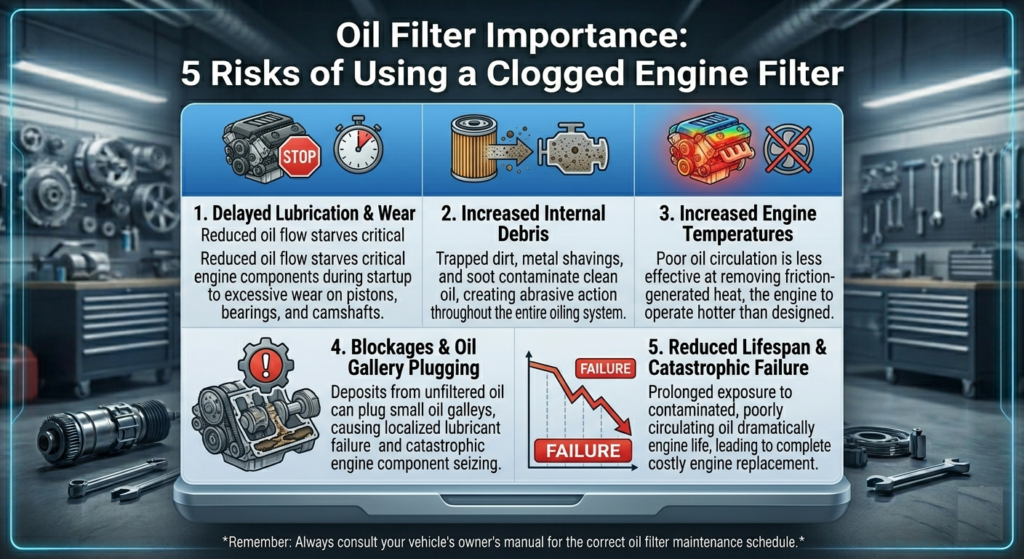
1. Accelerated Engine Wear and Internal Friction
The most immediate and severe consequence of a clogged oil filter is accelerated wear. Engines are built with incredibly tight tolerances. When the bypass valve opens due to a clog, the metal shavings and carbon particles that should have been trapped are instead forced into the tiny gaps between moving parts.
Oil Filter Importance: 5 Risks of Using a Clogged Engine Filter. This creates a cycle of destruction. The debris causes more friction, which grinds off more metal from the engine components, which in turn creates more debris. Over time, this leads to “scoring” on the cylinder walls and the wearing down of bearings. Once these components are damaged, the only fix is an expensive engine rebuild or replacement.
2. Significant Reduction in Fuel Efficiency and Performance
Oil Filter Importance: 5 Risks of Using a Clogged Engine Filter. Many drivers don’t realize that a clogged oil filter can hit them directly in the wallet at the gas pump. Lubrication is designed to reduce friction; friction creates resistance. When your engine is forced to run on dirty, gritty oil, the internal resistance increases significantly.
The engine has to work harder to overcome this “drag” to maintain its speed and power output. This extra effort requires more fuel. If you notice a gradual drop in your miles per gallon (MPG) along with a “sluggish” feeling during acceleration, a neglected oil filter could be the hidden culprit. Clean oil filtered through a fresh medium ensures that the engine operates at its peak thermal and mechanical efficiency.
3. Overheating: The Silent Engine Killer
Oil Filter Importance: 5 Risks of Using a Clogged Engine Filter. Motor oil does more than just lubricate; it is a vital part of the engine’s cooling system. While the radiator handles the top half of the engine, the oil carries heat away from the high-friction areas in the lower block, such as the crankshaft and bearings.
When an oil filter is clogged, the flow rate of the oil is often restricted, even if the bypass valve is open. This restricted flow means the oil stays in high-heat zones longer, absorbing more heat than it can dissipate. Furthermore, the increased friction from dirty oil generates even more heat. This double-whammy can lead to localized overheating, which can warp engine components or lead to a blown head gasket.
4. Increased Emissions and Environmental Impact
Oil Filter Importance: 5 Risks of Using a Clogged Engine Filter. A clogged filter can lead to a buildup of “sludge”—a thick, gel-like substance formed when oil breaks down and mixes with contaminants. This sludge can foul spark plugs and interfere with the combustion process.
When combustion is incomplete or when the engine is struggling, it produces more hydrocarbons and toxic gases. You might notice a “burnt oil” smell or even see darker smoke coming from the exhaust pipe. In many regions, a vehicle with a severely clogged filter and dirty oil may even fail an emissions test because the engine is simply not running “clean.”
5. Total Engine Failure (Seizing)
Oil Filter Importance: 5 Risks of Using a Clogged Engine Filter. This is the nightmare scenario for any vehicle owner. If the oil filter is so neglected that even the bypass valve becomes obstructed, or if the sludge buildup becomes thick enough to block the oil pickup tube, the engine will suffer from “oil starvation.”
Without a constant film of oil, the metal parts of the engine will make direct contact at high speeds. The heat generated by this contact is so intense that the parts can literally weld themselves together in a fraction of a second. This is known as “seizing” the engine. Once an engine seizes, it is usually a total loss, costing thousands of dollars to replace.
Symptoms of a Clogged Oil Filter to Watch For
Oil Filter Importance: 5 Risks of Using a Clogged Engine Filter. Because the oil filter is hidden inside a metal housing or tucked away under the engine, you can’t see it getting dirty. However, your car will give you warning signs:
-
Metallic Clanking Noises: If you hear a “ticking” or “knocking” sound, especially during startup, it means the oil is not reaching the upper engine fast enough.
-
The Oil Pressure Warning Light: Never ignore this light. It often means the pressure has dropped because the filter is restricted.
-
Persistent Dirty Oil: If you check your dipstick and the oil looks pitch black or gritty only a few hundred miles after an oil change, the filter was likely saturated and unable to clean the new oil.
Maintenance Best Practice: The “Every Time” Rule
Oil Filter Importance: 5 Risks of Using a Clogged Engine Filter. There is an old school of thought that suggests you only need to change the filter every other oil change. In modern vehicles, this is a dangerous myth. Modern engines run hotter and use thinner oils (like 0W-20) that are more susceptible to carrying contaminants. Given that a high-quality oil filter costs a fraction of the price of the oil itself—and a microscopic fraction of the price of an engine—there is no logical reason to skip a filter change.
Conclusion The oil filter is a small component that carries a massive responsibility. By ensuring you use a high-quality, synthetic-media filter and replacing it with every oil change, you are protecting your engine from friction, heat, and catastrophic failure. Don’t let a $10 part become the reason for a $5,000 repair bill.