Resetting Your Oil Light: What Happens If You Skip This Step?
Resetting Your Oil Light: What Happens If You Skip This Step? When you complete an oil change, the final step in the process is often overlooked or dismissed as a mere “cosmetic” adjustment: resetting the oil life monitoring system. For some drivers, the persistent “Change Oil Soon” light is simply a nuisance to be ignored. However, in the ecosystem of modern automotive electronics, this reset is far more than just turning off a dashboard reminder. It is a critical data synchronization between your engine’s physical state and its electronic brain.
In this detailed guide, we will explore the technical importance of resetting your oil light, the risks of overlapping service intervals, and why failing to perform this simple task can lead to long-term maintenance confusion and potential engine neglect.
The Two Types of Oil Monitoring Systems
To understand why the reset matters, we must first distinguish between the two types of systems found in vehicles today.
1. Mileage-Based (Timed) Systems
Resetting Your Oil Light. Older or more basic vehicles use a simple “countdown” timer. For example, the light is programmed to turn on every 5,000 miles. When you reset it, you are simply telling the computer to start counting from zero again. If you don’t reset it, the light will stay on or come on shortly after your service, making it impossible to know when your next 5,000-mile interval is actually due.
2. Intelligent Oil Life Monitors (IOLM)
Resetting Your Oil Light. Most modern vehicles (Post-2010) use complex algorithms. These systems do not just count miles; they monitor engine temperature, RPMs, idle time, and even ambient weather conditions. The computer uses this data to estimate the actual chemical degradation of the oil. When you reset an IOLM system, you are informing the Engine Control Unit (ECU) that the “base state” of the oil is once again at 100% quality.
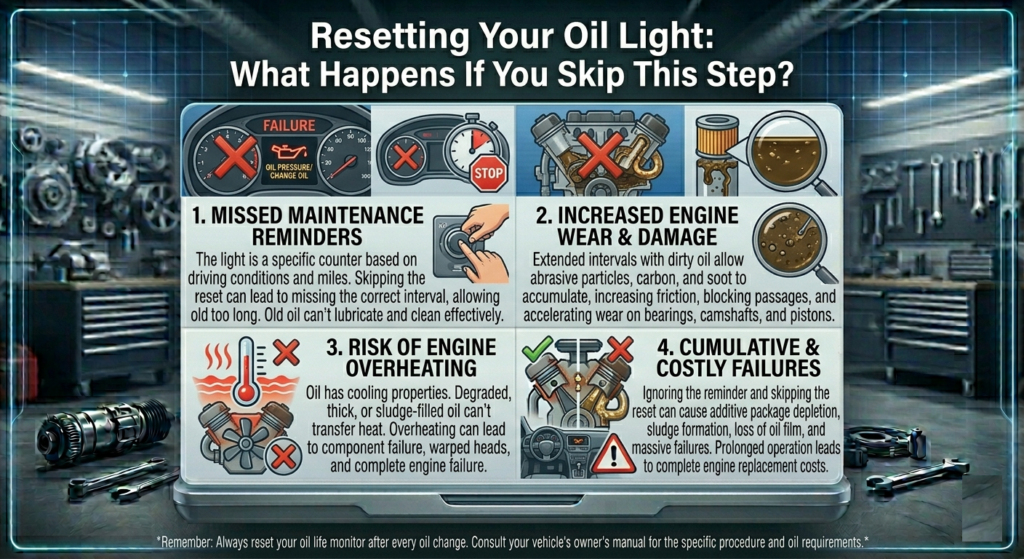
1. The Hazard of Overlapping Service Intervals
The most immediate consequence of failing to reset the light is the loss of your maintenance “anchor point.” If you change your oil at 50,000 miles but forget to reset the light, and the light finally triggers at 52,000 miles, you are left with a dilemma.
Do you change the oil again in 3,000 miles? Or do you try to remember to add 5,000 to your current mileage? Human memory is fallible. Over a year of driving, these small overlaps can lead to “maintenance drift,” where you inadvertently go 7,000 or 8,000 miles between changes because the electronic reminder was out of sync with reality. Over time, this cumulative neglect leads to sludge buildup and accelerated wear on the valvetrain.
2. The “Boy Who Cried Wolf” Phenomenon
Resetting Your Oil Light. Psychologically, driving with a persistent warning light on your dashboard is dangerous. When the “Change Oil” light is constantly illuminated because you neglected to reset it, you become desensitized to dashboard warnings.
Modern instrument clusters use shared zones for different warnings. If you are used to seeing a yellow maintenance light, you might not notice when a red Oil Pressure warning or a Check Engine Light appears. Desensitization leads to slower reaction times when a genuine mechanical emergency occurs. If your oil pressure drops while your maintenance light is already on, you might assume it’s just the same old reminder—until the engine seizes.
3. Accuracy of Intelligent Maintenance Algorithms
Resetting Your Oil Light. As mentioned earlier, systems like Honda’s Maintenance Minder or Ford’s IOLM calculate oil life based on usage patterns. If you drive in heavy stop-and-go traffic or extreme heat, the computer will shorten the interval.
If you do not reset the system, the computer continues to apply the degradation logic from the old oil to the new oil. This means the sensors may trigger a “0% Oil Life” warning much sooner than necessary, or worse, it may fail to accurately track the high-heat cycles of the new lubricant. For the computer to do its job, it needs a “Zero Point” (the reset) to begin its complex calculations accurately.
4. Impact on Vehicle Resale Value and Records
Resetting Your Oil Light. In the age of digital vehicle history reports (like Carfax), maintenance transparency is a major factor in resale value. Many modern vehicles store maintenance “events” in the ECU. When a technician or a savvy buyer plugs a diagnostic tool (OBD-II) into the car, they can see when the last reset was performed.
If you claim to have changed the oil every 5,000 miles but the internal computer shows the oil hasn’t been reset in 15,000 miles, it creates a “red flag.” It suggests that the vehicle was maintained inconsistently or by someone who didn’t understand the technical requirements of the car. A documented history of timely resets is proof of a meticulously maintained engine.
The Difference: Maintenance Light vs. Oil Pressure Light
It is vital to clarify a common misconception that leads to engine failure:
-
Maintenance/Oil Life Light (Yellow/Orange): This is a reminder based on time or mileage. It means “Plan a service soon.” You can usually drive for a few hundred miles with this light on.
-
Oil Pressure Light (Red Oil Can): This is a mechanical emergency. It means there is no oil moving through the engine. If this light comes on, you must stop the car immediately.
If you don’t reset your maintenance light, you might confuse the two, or the maintenance light might “mask” the appearance of the pressure light on some digital displays.
Why Mechanics Sometimes Forget the Reset
Resetting Your Oil Light. Even professional lube shops occasionally forget to perform the reset procedure. This usually happens because every car is different. Some require a specific sequence of “gas pedal pumps,” while others require navigating deep into the touchscreen menus.
This is why resources like oilchangelight.net are essential. We provide the specific “cheat codes” for every make and model so that you can ensure your car’s electronic brain is as fresh as the oil in its crankcase.
Conclusion: The Reset is the “Handshake” of Maintenance
Resetting Your Oil Light. Think of the oil change reset as a handshake between the mechanic (or you) and the vehicle. It is the confirmation that the physical work has been completed. By taking sixty seconds to navigate the menu or perform the pedal sequence, you are ensuring that your engine’s protection algorithm is accurate, your dashboard is clear of distractions, and your maintenance records are flawless.
An oil change isn’t truly finished until the dipstick is full and the dashboard says 100%.