Understanding Motor Oil Viscosity: 5W-30 vs 10W-40 Differences
Understanding Motor Oil Viscosity Differences. If you have ever looked at a bottle of motor oil, you have likely seen alphanumeric codes like 5W-30 or 10W-40. While these numbers might seem like arbitrary industry jargon, they represent the most critical technical characteristic of the oil: its viscosity. Choosing the wrong viscosity for your engine is not just a minor error; it can lead to poor fuel economy, increased engine wear, and even catastrophic failure in extreme weather conditions.
In this comprehensive guide, we will break down the science of viscosity, explain how the SAE (Society of Automotive Engineers) rating system works, and compare two of the most popular oil grades—5W-30 and 10W-40—to help you understand which one is best for your specific driving environment.
What Exactly Is Motor Oil Viscosity?
Understanding Motor Oil Viscosity Differences. In simple terms, viscosity is a measure of a fluid’s resistance to flow. Imagine pouring honey and water out of two different jars. The water flows quickly because it has low viscosity, while the honey flows slowly because it has high viscosity.
In an internal combustion engine, oil viscosity is a balancing act. The oil must be thin enough to flow instantly to the top of the engine during a cold start, but thick enough to maintain a protective film between moving metal parts when the engine reaches its operating temperature of roughly 212°F (100°C). If the oil is too thin, it won’t provide a sufficient barrier; if it is too thick, the engine has to work harder to move it, leading to “drag” and overheating.
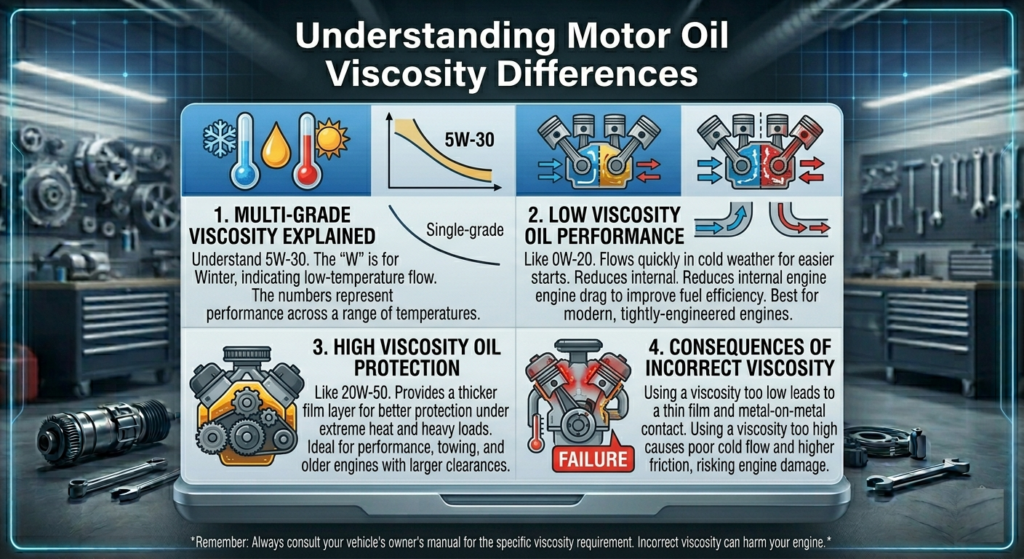
Decoding the SAE Rating: What the Numbers Mean
The standard format for motor oil viscosity (e.g., 5W-30) is known as a “multi-grade” rating. This system tells us how the oil performs at two different temperature extremes.
The First Number and the “W” (Winter)
Understanding Motor Oil Viscosity Differences. The first part of the code (e.g., 5W) refers to the oil’s flow characteristics at low temperatures. Contrary to popular belief, the “W” stands for Winter, not Weight.
-
A lower number (like 0W or 5W) means the oil remains thinner in cold weather. This allows the oil pump to push the lubricant to the camshafts and valves within seconds of turning the key, preventing “dry starts” which cause the most wear in an engine’s life.
The Second Number (Operating Temperature)
Understanding Motor Oil Viscosity Differences. The second number (e.g., 30 or 40) represents the oil’s viscosity at the engine’s normal operating temperature.
-
A higher second number indicates a “thicker” oil that provides a more robust protective film under high heat and heavy loads. However, thicker oil also creates more internal resistance, which can slightly decrease fuel efficiency.
The Great Comparison: 5W-30 vs. 10W-40
| Feature | 5W-30 Motor Oil | 10W-40 Motor Oil |
| Cold Start Performance | Excellent; flows quickly in freezing temperatures. | Moderate; thicker in the cold, requiring more effort to circulate. |
| High-Temperature Protection | Optimized for modern, fuel-efficient engines. | Superior for older engines or high-heat environments. |
| Fuel Economy | Higher efficiency due to lower internal drag. | Lower efficiency due to higher viscosity. |
| Typical Use Case | Newer passenger cars and daily commuters. | High-mileage vehicles, trucks, and older engine designs. |
When Should You Use 5W-30?
Understanding Motor Oil Viscosity Differences. The 5W-30 grade is currently the most widely recommended oil for modern passenger vehicles. Engineers design today’s engines with incredibly tight tolerances—the gaps between moving parts are microscopic.
-
Precision Lubrication: 5W-30 is thin enough to penetrate these tight gaps effectively.
-
Fuel Savings: Because it is a “thinner” oil at operating temperature compared to a 40-grade oil, it reduces the energy the engine needs to pump the oil, resulting in better MPG.
-
Versatility: It provides excellent protection in a wide variety of climates, from sub-zero winters to standard summer heat.
When Should You Use 10W-40?
Understanding Motor Oil Viscosity Differences. While 5W-30 is the modern standard, 10W-40 still plays a vital role in the automotive world, particularly for specific niche applications.
-
High-Mileage Engines: As engines age, the internal seals and gaskets begin to shrink, and the gaps between metal parts increase due to years of friction. A thicker oil like 10W-40 can help “fill” these wider gaps, reducing oil consumption and dampening engine noise.
-
Extreme Heat and Heavy Loads: If you are driving a heavy-duty truck in a desert climate or towing a trailer across a mountain pass, the engine generates massive amounts of heat. In these scenarios, a 40-weight oil provides a thicker “cushion” that is less likely to break down under extreme thermal stress.
-
Leak Prevention: Because 10W-40 is thicker, it is less likely to seep through small cracks in old gaskets compared to a thinner 5W oil.
The Science of Viscosity Index Improvers
Understanding Motor Oil Viscosity Differences. Multi-grade oils like 5W-30 and 10W-40 are made possible by “Viscosity Index Improvers” (VIIs). These are polymer molecules that expand as they get hot.
-
When the oil is cold, these polymers stay coiled up, allowing the oil to flow like a 5-weight or 10-weight oil.
-
As the engine heats up, the polymers uncoil and branch out, preventing the oil from thinning out too much and allowing it to behave like a 30-weight or 40-weight oil.
Using high-quality synthetic oil is crucial because cheap mineral oils use lower-quality polymers that can shear or break down over time, causing the oil to lose its “multi-grade” properties and fail to protect the engine when it’s hot.
The Risks of Using the Wrong Viscosity
Understanding Motor Oil Viscosity Differences. What happens if you use 10W-40 in an engine designed for 5W-20 or 5W-30?
-
Oil Starvation at Startup: In cold weather, the 10W oil will be too thick to reach the top of the engine quickly. This can lead to “clattering” sounds and premature wear on the valvetrain.
-
Reduced Cooling: Oil is responsible for carrying heat away from the engine block. If the oil is too thick, it moves slower, meaning it spends more time in “hot spots” and can’t dissipate heat efficiently.
-
Check Engine Lights: Many modern cars use oil pressure to control Variable Valve Timing (VVT) systems. Using oil that is too thick can throw off the timing sensors, triggering a dashboard warning light.
Conclusion: Trust the Manufacturer’s Manual
Understanding Motor Oil Viscosity Differences. While it might be tempting to switch to a thicker oil to “protect the engine better,” the best course of action is almost always to follow the recommendation printed in your owner’s manual or on the oil filler cap.
Engineers have spent thousands of hours testing your specific engine to determine the exact viscosity required for the best balance of protection, cooling, and efficiency. Unless you are driving a high-performance track car or a vintage vehicle with significant wear, sticking to the factory-recommended 5W-30 is usually your safest bet for a long-lasting engine.