Why Is My Car Burning Oil? Causes and Prevention Strategies
Why Is My Car Burning Oil? Causes and Prevention Strategies. Finding that your engine oil level has dropped significantly between service intervals is a moment of pure anxiety for any driver. While a small amount of oil consumption is considered “normal” by many manufacturers, a rapid disappearance of lubricant usually points to one of two expensive problems: an external leak or internal oil burning. If you don’t see puddles on your driveway, your engine is likely “consuming” the oil internally.
In this comprehensive guide, we will analyze the mechanical reasons behind internal oil consumption, explain how a $20 part can sometimes cause a $2,000 problem, and provide actionable strategies to prevent your engine from burning oil prematurely.
The Fundamental Question: Is It Leaking or Burning?
Before diving into the “why,” you must determine the “how.”
-
Oil Leaking: This is an external issue. You will see dark spots on the ground, or a greasy film coating the lower parts of the engine block. It is often caused by failing gaskets (valve cover, oil pan) or degraded seals (crankshaft seals).
-
Oil Burning: This is an internal issue. The oil is entering the combustion chamber, mixing with fuel and air, and being ignited. It then exits through the exhaust system. This is far more dangerous for the engine’s long-term health because it can foul spark plugs, clog catalytic converters, and lead to total engine failure.
1. Worn Piston Rings: The Primary Source of Oil Consumption
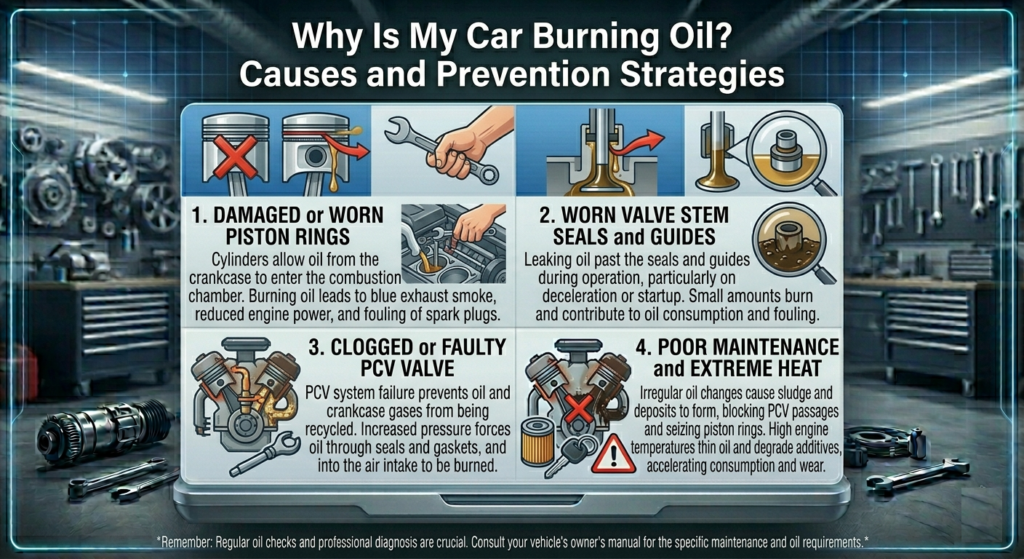
Why Is My Car Burning Oil? Causes and Prevention Strategies. The most common reason an engine burns oil is the degradation of the piston rings. Every piston has a set of rings designed to create a tight seal against the cylinder wall. Their job is twofold: to keep the high-pressure combustion gases in the chamber and to “scrape” the oil off the cylinder walls as the piston moves down.
Over hundreds of thousands of miles—or due to poor maintenance—these rings can wear down or become “stuck” due to carbon deposits. When the seal is compromised, oil stays on the cylinder walls during the combustion stroke. It is then burned away in a flash of heat. This is known as “oil blow-by.” If you see blue-tinted smoke coming from the exhaust while accelerating, your piston rings are likely the culprit.
2. Damaged Valve Stem Seals: The “Cold Start” Smoke Signal
Why Is My Car Burning Oil? Causes and Prevention Strategies. Inside the cylinder head, the intake and exhaust valves move up and down thousands of times per minute. To prevent oil from the top of the engine from seeping down into the cylinders, engineers use small rubber or silicone “valve stem seals.”
Over time, the extreme heat of the engine causes these seals to become brittle and crack. When the car sits overnight, oil slowly drips past the seals and pools on top of the pistons. When you start the car in the morning, this oil burns off all at once, creating a large cloud of blue smoke that disappears after a few minutes. This is a classic symptom of failing valve stem seals.
3. Faulty PCV (Positive Crankcase Ventilation) System
Why Is My Car Burning Oil? Causes and Prevention Strategies. Many drivers are surprised to learn that a tiny, inexpensive plastic component called the PCV valve can be the reason they are losing quarts of oil. The PCV system is designed to redirect “blow-by” gases from the crankcase back into the intake manifold to be burned off cleanly.
If the PCV valve gets stuck in the “open” position, it can create a vacuum that literally sucks oil mist out of the crankcase and into the engine’s air intake. This oil is then burned in the combustion chamber. The good news? A PCV valve usually costs less than $30 and can be replaced in minutes. If you are burning oil, always check the PCV system first before assuming you need a major engine rebuild.
4. Turbocharger Seal Failure in Modern Engines
Why Is My Car Burning Oil? Causes and Prevention Strategies. As more modern cars move toward small, turbocharged engines, the turbo itself has become a common point of oil loss. Turbochargers rotate at incredibly high speeds—often over 100,000 RPM—and require a constant flow of oil for cooling and lubrication.
The turbo has internal seals that keep the oil separate from the air being forced into the engine. If these seals fail, the turbo will pump motor oil directly into the intake tract or the exhaust system. This results in massive oil consumption and thick clouds of smoke. Because turbos operate at such high temperatures, using anything less than high-quality full synthetic oil can lead to “coking” (oil turning into hard carbon), which destroys these seals.
Visible Symptoms: Identifying the Smoke Colors
Your exhaust pipe is a diagnostic tool. Pay attention to the color of the smoke to identify the severity of the oil-burning issue:
| Smoke Color | Meaning | Urgency |
| Thin White/Vapor | Normal condensation (water vapor). | None. |
| Thick White/Acrid | Coolant leaking into combustion. | High (Head Gasket). |
| Black Smoke | Too much fuel (Rich mixture). | Moderate (Fuel Injectors). |
| Blue/Gray Smoke | Oil is being burned. | High (Rings, Seals, or PCV). |
How to Prevent Your Engine from Burning Oil
While some mechanical wear is inevitable, you can significantly delay or prevent oil consumption by following these four strategies:
A. Never Skip an Oil Change
Why Is My Car Burning Oil? Causes and Prevention Strategies. The primary reason piston rings and valve seals fail is the buildup of carbon and sludge. Old oil loses its ability to keep contaminants in suspension. These contaminants turn into a “gritty” paste that acts like sandpaper on your piston rings. Fresh oil keeps these components clean and moving freely.
B. Use the Correct Viscosity and Quality
Using an oil that is too thin (e.g., using 0W-20 in an engine that requires 5W-30) can lead to higher consumption because the oil can more easily seep past aging seals. Additionally, always use oils that meet the manufacturer’s specific API or ACEA standards to ensure the additive package can handle the engine’s heat.
C. Replace the PCV Valve Every 50,000 Miles
Why Is My Car Burning Oil? Causes and Prevention Strategies. Do not wait for the PCV valve to fail. Treat it as a “wear item” similar to a spark plug or an air filter. Replacing it proactively is the cheapest way to prevent unnecessary oil consumption and high crankcase pressure.
D. Avoid Excessive Idling and Short Trips
Why Is My Car Burning Oil? Causes and Prevention Strategies. Engines that never reach full operating temperature are prone to “carbon fouling.” This carbon builds up around the piston rings, causing them to stick. Once they stick, they can no longer seal against the cylinder walls, and the oil-burning cycle begins.
Conclusion: Monitoring Is the Best Medicine
Why Is My Car Burning Oil? Causes and Prevention Strategies. If your car is burning oil, it doesn’t always mean the engine is “dead.” By identifying the cause early—whether it’s a simple PCV valve or a turbo seal—you can often save the vehicle from a total breakdown. The most important habit you can develop is checking your dipstick every two weeks. Catching a low-oil condition early prevents the friction and heat that turn a “burning oil” problem into a “seized engine” disaster.